
A newborn under three months may require four to five diaper changes a day due to spit-ups and leaks. Starting from this physiological reality allows for a functional wardrobe to be sized appropriately, without unnecessary surplus. Knowing the right number of pieces per size helps avoid both the Sunday night panic and the accumulation of never-worn clothes.
Baby capsule wardrobe: the principle of laundry rotation
We recommend calibrating the number of pieces based on a three-day laundry cycle. This rhythm covers most households without requiring the storage of dozens of identical bodysuits.
For a newborn (size birth to 1 month), five to seven bodysuits and four to five pajamas are sufficient if the machine runs twice a week. In size 3 months, the peak of soiling due to spit-ups justifies adding one or two extra bodysuits. Beyond six months, the introduction of solid foods dirties tops more than bottoms, which changes the distribution.
The capsule logic relies on a core of interchangeable cotton pieces, complemented by one or two thermal adjustment layers (cardigans, sleep sacks). To better estimate how many clothes according to the baby’s age, it is useful to think in terms of combinable pieces rather than complete outfits. Matching sets are appealing in stores but rigidify the rotation.

Birth season and overheating risk: adjust quantities
The birth season radically changes the composition of the layette. A baby born in July does not need four woolen sweaters, but rather short-sleeved bodysuits in sufficient numbers to compensate for sweating.
The risk of overheating is often underestimated in most buying guides. A newborn poorly regulates their body temperature. Adding layers of clothing “just in case” increases this risk, especially at night. We recommend thinking in terms of layers of fabric rather than the number of clothes:
- In summer, a sleeveless bodysuit and a light sleep sack (TOG 0.5 to 1) often constitute the sufficient nighttime outfit
- In winter, a long-sleeved bodysuit, pajamas, and a thicker sleep sack (TOG 2 to 2.5) effectively replace the addition of a blanket, which is not recommended for infants
- In mid-season, a cotton or fine knit cardigan serves as an adjustable variable, removed or added according to the room temperature
Adjusting quantities to the season can reduce the layette by about a third compared to the “universal” lists found online.
Prematurity and childcare mode: two overlooked variables
A premature baby wears the birth size much longer than a full-term baby. Planning for more pieces in premature size (or “preemie”) becomes relevant, while for a standard-sized baby, this size is often worn for less than two weeks.
The mode of childcare also influences quantities. In collective daycare, we observe that it is necessary to systematically leave two to three spare outfits on-site, in addition to the home wardrobe. This represents a real need for additional pieces that classic lists do not account for. In exclusive parental care, this buffer stock disappears.
Bodysuits and pajamas: quantities by age group
| Age Group | Bodysuits | Pajamas | Sleep Sacks | Tops / Bottoms (from 6 months) |
|---|---|---|---|---|
| Birth – 1 month | 5 to 7 | 4 to 5 | 2 | – |
| 1 – 3 months | 7 to 8 | 5 to 6 | 2 | – |
| 3 – 6 months | 6 to 7 | 4 to 5 | 2 | 2 to 3 sets |
| 6 – 12 months | 5 to 6 | 4 to 5 | 2 | 4 to 5 sets |
These ranges assume a three-day laundry cycle and one child. With twins, apply a factor of 1.5 rather than doubling (the laundry is shared).
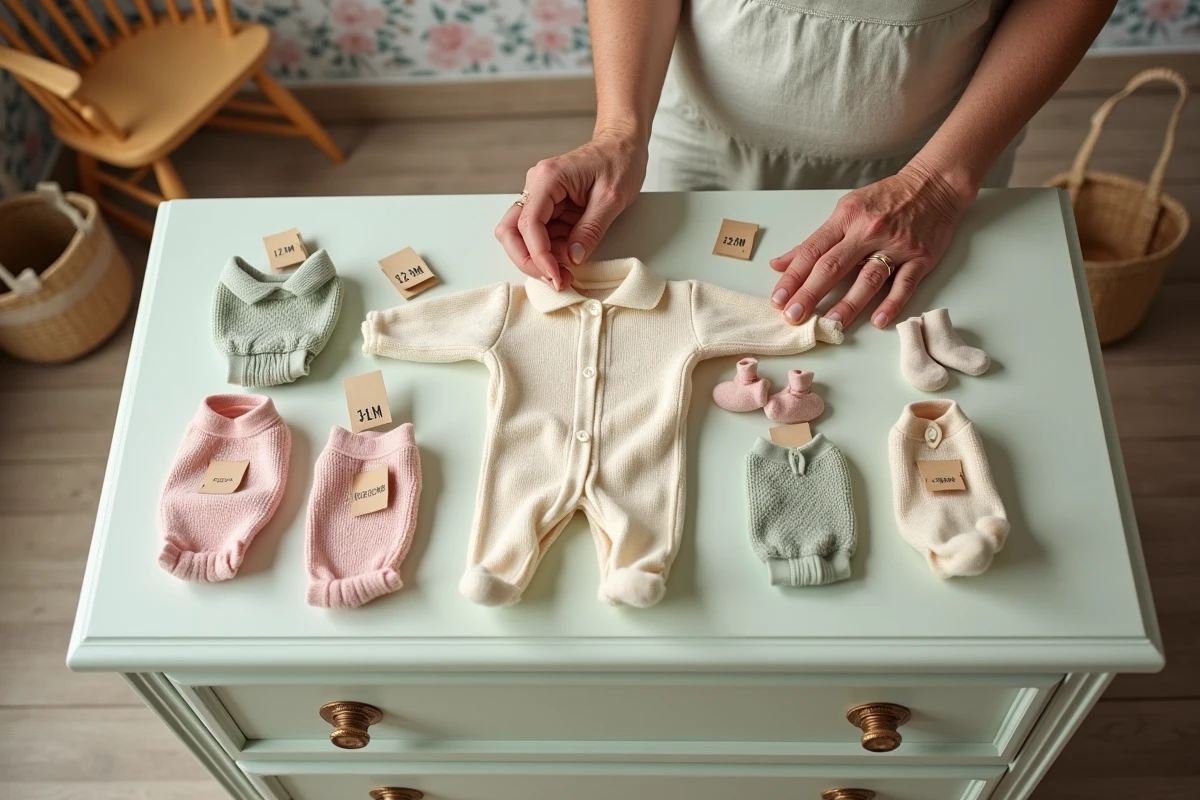
Budget and textile footprint: rental, second-hand, and the AGEC law
Reducing the number of new pieces purchased remains the most effective lever to limit both spending and environmental impact. The rapid growth of a newborn makes each size ephemeral, making baby clothing one of the segments with the lowest utilization rate per piece.
Second-hand (wardrobe sales, charities, resale platforms) covers most needs for bodysuits and pajamas without compromising on quality, provided the elasticity of necklines and the condition of snap buttons are checked. Cotton withstands many washes, making it a suitable fiber for reuse.
Rental of baby clothes, still marginal, is developing in France. The model is particularly suitable for technical pieces (winter coats, ski suits) worn for only a few weeks. For everyday pieces, the rotation is too rapid for rental logistics to be relevant.
AGEC law and product information
Since the gradual implementation of the AGEC law, baby clothing brands must display information about the environmental qualities of their products. This requirement promotes capsule layettes by guiding parents towards durable pieces rather than the accumulation of cheap, short-lived clothing.
Choosing five certified organic cotton bodysuits rather than ten cheap synthetic bodysuits is not just an ecological choice. It is also a practical calculation: fewer pieces to sort, store, and pass on when the size change occurs, which happens faster than one might think.