
40%. That’s the share of Vietnam in global shoe production. This figure, raw and straightforward, illustrates a silent yet decisive shift at the heart of the global industry. Far behind, China sees its dominance erode year after year, while Germany, discreet yet tenacious, continues to ship its niche models to Japan or the United States at prices that would make many of its competitors pale.
Major international brands challenge the obvious: they do not always chase the lowest price. Some choose to bring part of their production back, while others bet on countries like Indonesia or Cambodia, less exposed in the media, but where quality, speed, or consideration of social issues take precedence over the simple question of cost.
Overview of the main manufacturing countries: where are Adidas shoes and their competitors made?
The face of shoe manufacturing is constantly evolving, but a trio still dominates the scene. Vietnam, Indonesia, China: these three giants carve out the lion’s share, imposing their rhythm on the entire planet. Vietnam, at the forefront, has managed to capture the attention of major brands thanks to a skilled workforce and tailor-made industrial policies. Millions of pairs pass through its factories each year before landing in Western markets.
In China, the landscape is changing, but the influence remains strong. Colossal infrastructures, an ability to adapt in real-time to new trends, and cities like Guangzhou or Putian that house hundreds of factories capable of producing both entry-level sneakers and luxury models. Competition, however, is intensifying. Indonesia is gradually establishing itself, driven by a trained youth and attractive costs, thus capturing an increasingly significant share of sports shoe orders.
In Europe, Portugal stands out as the pillar of the continent. In the Porto region, workshops combine tradition and innovation, appealing to brands looking for flexibility and the ability to launch limited series for demanding clients.
To delve deeper into this overview, the best countries for shoe manufacturing provides a detailed analysis of the sector. Between quality requirements, search for flexibility, and cost optimization, the global map continues to be redrawn.
Quality, working conditions, environment: what the location choices reveal
The stakes go far beyond the question of cost. Behind the address of each factory, three dimensions now prevail: the quality of the finished product, respect for working conditions, and consideration of the environment. In Southeast Asia, mass production no longer only means volumes. In Vietnam, quality controls are multiplying, with each pair undergoing scrutiny before leaving the workshops. China, too, is adjusting its standards to meet the increasingly demanding requirements of Western clients.
In Europe, some countries are making their mark by betting on expertise and adherence to standards. Portugal stands out for its expertise, the use of local materials, and increased attention to social rights and the environment. Italy, on its part, maintains its aura, driven by a craft tradition and an innovative capacity that remains a reference. Conversely, pressure on supply chains still exposes some Asian sites to issues regarding safety or working conditions.
Another criterion that has become essential: ecological impact. The origin of raw materials, reduction of transport distances, and waste management are now key factors in location decisions. Today, traceability and carbon footprint are priorities, just like transparency in production practices. This movement pushes each brand to rethink its approach: making shoes today also means meeting expectations that go beyond just the price.
Adidas, Asics, New Balance: what are the major differences in manufacturing strategies?
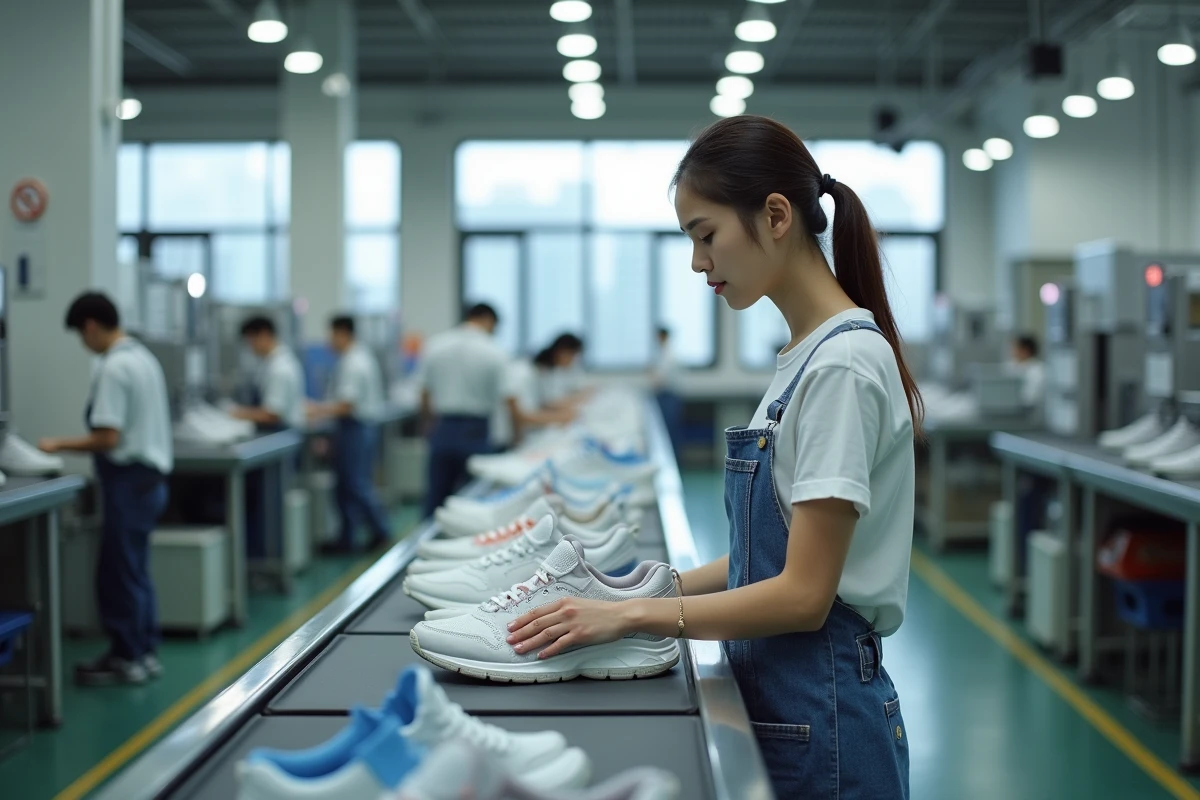
Major sports shoe brands tread a fine line: producing on a large scale, diversifying ranges, while adapting to the volatility of the global market. At Adidas, diversifying production sites is not a choice, but a necessity. The company distributes its manufacturing between Vietnam, Indonesia, and China to respond to demand fluctuations and limit logistical uncertainties. This organization relies on refined specialization: some workshops prioritize artisan quality, while others focus on mass production.
Asics adopts a distinctly different method. Its priority: innovation and traceability of raw materials. Asian partners are carefully selected, subjected to strict quality controls and high environmental responsibility standards. The production sites, mainly located in Vietnam or Indonesia, benefit from constant investments to ensure compliance with social standards.
New Balance, finally, plays the European card for part of its production, particularly in Portugal. This choice is based on local expertise and targets high-end models, while reducing dependence on large Asian factories. Behind the scenes, localization shapes the entire range strategy, from exclusive technical models to more accessible collections.
Each brand has its vision, each site its specifics. The shoe, a universal product, thus becomes a reflection of a world where the boundaries of production shift according to demands, innovations, and commitments. Tomorrow, which city, which country will emerge as the new global capital of shoes? The match remains open, and nothing indicates it will be judged by the old rules.